Showing posts with label Food. Show all posts

Monday, May 10, 2010

Foods of Ghana

Once you get used to the mechanics of swallowing balls of starch whole, the food of Ghana is quite enjoyable. In most restaurants you can buy rice and either chicken or fish, but if you have a more traditional meal you might not know how to proceed.
Ghanaians typically prepare some kind of starch, usually either corn or cassava, which they eat with a meat stew. You may or may not be provided utensils. If not, use your right hand (never your left) to pinch off a ball of the starchy stuff, dip it in the stew, and swallow it whole. You can pick at the larger meat chunks with your hand and eat them alone. That's the basic idea.
Fufu - pounded cassava. The "soft" preparation is pounded longer than the "hard" version, and is pretty sticky.
Banku - Cassava flour mixed with corn flour, and prepared like fufu.
Kenkey - Corn flour prepared like a mexican tamale, but fermented a little. It's kind of an acquired taste. I enjoy it, but prefer young kenkey, as its texture is softer and the flavor isn't as pronounced.
The stew is usually made with tomatoes, onions, palm seeds, and Ghanaian peppers (they look like habaneros, but are much milder), with whatever meat is available.
There is also a dish made with black-eyed peas, that tastes Indian. Ghanaians do use Indian-style curry in some of their dishes.
Most restaurant meals include fried plantains. They are like heavier, starchier orange bananas, and they are delicious. I would recommend cooking them in the states. You can buy them at any hispanic grocery store.
Ghanaians eat a lot of fruit: white or yellow pineapple, mango, watermelon, papaya, and bananas are the most common things I've seen. Vegetables are another story--you normally have to go to a nice hotel to get even a salad, and they aren't very good. Vegetables are expensive and can contain parasites in their stalks.
There is a very cheap ice cream called Fanice, that you can buy on any street corner. It's about 40 pesewas (26 cents), and it comes in a little plastic wrapper kind of like Gogurt. I like the vanilla best, but the chocolate is good also.

Saturday, September 19, 2009

Jamaican Food


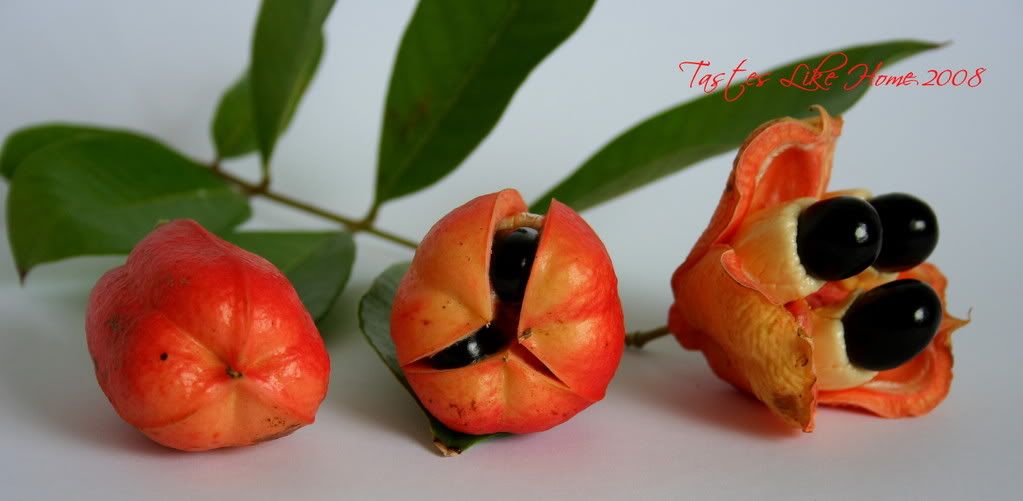
I was browsing around the other day and found this recipe for a Jamaican dish called "ackee and saltfish." It is the national dish of Jamaica, and contains peppers, onions, flaked fish, and ackee, a very strange fruit that apparently resembles and tastes like scrambled eggs!

I decided that I had to try it. I went to an ethnic grocery store looking for ackee, but to no avail. The dish is usually made with salted cod, I assume because two hundred years ago the ships would bring cheap dried fish

from Boston in exchange for sugar cane and rum. Now the cod probably comes from Norway. I settled for two large fillets of frozen grey sole. They were beautiful, white fillets that didn't smell fishy at all.

When I got home I marinated the fish in lime juice, salt, pepper, paprike, and a little allspice (what's Jamaican food without allspice?).

I let that sit awhile and sautéed two bell peppers with an onion and some cayenne pepper in butter. I threw in some thyme, salt, and pepper.

Meanwhile, I cooked the fish and flaked it with a fork. Once it was done I tossed in the vegetables, then scrambled five eggs and gently mixed them in.

For the sides, I nuked a sweet potato for a few minutes, then sliced it up and browned it in butter with salt and pepper. We had a can of mangosteens, so we added them on the side.
Our house smelled wonderful! It was a combination of caramelized onions, thanksgiving yams, and a hint of fried eggs.

I have to put in a note about mangosteens: I've only had them canned, but they are supposedly the most delicious fruit in the world. They look like white peeled tangerines. Each little section tastes halfway between a pear and a grape, with brilliantly sweet citrus overtones. At $4 it was easily the most expensive part of the meal, but definitely worth it.

This was a memorable meal, and very cheap. The fish and eggs went wonderfully with the onions and peppers. The sweet and salty yams provided a wonderful foundation, and a bite of mangosteen added a bit of tang at the end. We fed five people for about $10.

Tuesday, July 28, 2009

Grocery Co-op: Cut Your Grocery Bill in Half

We recently discovered our local grocery co-op, and I think it's an amazing way to save money on food. In case you don't know what that is, it's a group of people who pool their money together to buy something straight from a wholesaler in order to save money.

Once a month, the co-op puts together a basket of various groceries and you call in and tell them how many baskets you want (a basket usually includes three kinds of meat, four kinds of fruit, five veggies, and some other stuff). Near the end of the month the co-op places the order directly from wholesalers and distributes it to various drop-off locations. Then you just show up at your local drop-off location and pick up your food.

We have been participating in our local food co-op for three months now, and we just love it. The food is very high quality and we end up paying about half what we normally would at the grocery store. There's a variety of different items and it changes every month, so it's kind of an exciting surprise to see what you will get.

I would highly recommend joining a food co-op. Here's an online directory if your interested: http://www.coopdirectory.org/

Simplifying the Food in Your Life

In a recent blog post I outlined our current problems with food. Basically, we spend too much for it, waste a lot of it, and often opt for fast food whenever we don't feel like cooking.

Being unemployed means we have to downsize our budget, but we see it as an opportunity to start eating inexpensive, simple, healthy food instead of the expensive chemical creations we pick up at the golden arches.

I went on a research trip to Maine a few months ago, and while we were eating sandwiches at this little cafe I noticed the quaint little chalkboard set up with the menu scrawled on it. For some reason that stuck in my mind, and I realized that it was the solution to our food problems--we could keep track of our food on a menu board.

We went to Home Depot and bought a sheet of marker board masonite for $13 and cut it into a few manageable pieces. I found some double-sided adhesive tape and mounted the piece of marker board on the wall next to the fridge. Voila!

We took inventory of our food, listing the meats, fruits, breads, etc. in different sections of the menu board. We also added a section for leftovers so we'd make sure to eat them. We try to keep it updated as we use stuff, but we erase the board and take inventory again once a week.

The menu board has really simplified our cooking. Instead of planning dinner we look at the board and throw together whatever looks good--we might microwave some yellow squash and toss it with pasta and a quickly-sauteed chicken breast and a pear on the side, or we'll broil some cheese on thick pieces of toast with Italian sausage and dice up some peaches and celery sticks to eat with it. Dinner usually takes us all of 15 minutes to prepare and clean up, and it's usually much healthier than what we used to eat.

This also saves us quite a bit of money on groceries. Instead of planning meals and buying those ingredients, we just buy whatever's on sale to fill up slots on the board. Our shopping list might look like this:

milk
eggs
2 bread
3 veggies
4 fruits
2 meat
cheese

and we just look for inexpensive options for each of those.

Another benefit of this is that you can do interesting ethnic foods. We just had a Mexican week--we shopped at one of those really cheap hispanic markets and ate Mexican food--made our own refried beans and ate everything on tortillas. We might do an Asian week next.

Sunday, July 12, 2009

Orange Peel Tea

I had a crazy idea yesterday. I was standing on the front porch eating an orange I had sliced up. I was about to go throw away the leftover peels when I glanced at our spice shelf and saw our box of mandarin orange tea. I thought, "what the heck, I got five minutes. Might as well try to make my own."

I put some water on to boil, threw in the orange peels, three hibiscus flowers (you can buy bags of them at hispanic markets--they're cheap), a clove, and some cinnamon. I let it boil for a minute and turned the heat off, letting it steep for about an hour. I strained out the orange peel and other stuff, and sweetened the tea with honey. It had a rich red color from the hibiscus and was much more flavorful than the store-bought tea I was used to drinking.

Alisha and I sat on the porch, watching the rain, drinking homemade orange tea sweetened with honey. It was a very nice moment.

Aguas Frescas--A Great Way to Use Up Fruit

We just discovered a wonderful way to use up fruit that's sitting around. I used to live in a hispanic community in Los Angeles, and every restaurant serves aguas frescas. They're iced fruit drinks stored in huge glass jars--common flavors are horchata (rice and cinnamon), Jamaica (hibiscus flower), and Tamarindo (a sweet/sour paste extracted from the long seed pod of the tamarind tree). They also make them out of almost any kind of fruit.

Here's the recipe--it's as simple as you can get:

2-3 cups fruit (cut up, mashed, or sliced)
3-4 cups water
1/2 - 1 cup sugar

Place fruit in the blender with the sugar and fill to the top with cold water. Blend until you have a liquid consistency. Serve with ice, if desired.

We make this all the time, using whatever fruit happens to be in season. Right now our favorites are watermelon (sandia) and strawberries (fresa).

Note: you can good deals on fresh fruit by visiting hispanic supermarkets.

Food Problems

I must say that like many others I have an interesting relationship with food. I eat too much of it, pay too much for it, and end up wasting half of it. Some months Alisha and I pay as much for food as we do for rent. Here's the usual scenario:

Monday: We go to the grocery store and grab a bunch of stuff that we think we need. We make a few passes through the store, spend WAY too much time there, and when we finally get to the checkout we find that we have $200 worth of groceries in our cart. Even though our car is full of food, we grab some Taco Bell on the way home.

Tuesday: Alisha decides that she wants to make butternut squash soup. We bought the squash yesterday, but don't have celery or carrots. We make another trip to the store. Not only do we pick up the veggies, but we remember that we are out of Corn Pops, buy four boxes of cereal in addition to Corn Pops, and ten other items that we forgot yesterday. The total comes to $75. We're so tired when we get home that we eat Corn Pops for dinner and forget the soup.

Wednesday: We finally make the soup, creating a HUMONGOUS mess in the kitchen. We invite some friends over for dinner and enjoy the soup in those nice square, china bowls we registered for but rarely use because we're afraid of breaking them. After the friends leave our house is a disaster and we have a week's worth of leftover soup.

Thursday: I bring some of the soup to work for lunch. It tastes even better after the flavors mix for a day. I get home from work and we're overwhelmed by the messy house, so we go out to eat at a Chinese restaurant. Those leftovers go into my lunch for tomorrow.

Friday: We're both tired of leftover soup, so it gets pushed to the back of the fridge behind that half-watermelon and is forgotten, eventually spoiling. For some reason we can't think of anything to eat, so we cook bacon and eggs.

Saturday: Finally a day off! I wake up late to a stinky house and tackle the dishes from Wednesday. I discover that the fridge was set too low and most of the fruits and veggies are now frozen. I throw them out and make a new shopping list that we will forget to bring to the store on Monday. I'm a little burned out after spending the entire morning cleaning the kitchen, so we go out for Thai food.

Sunday: Alisha and I sit down and talk about how to use up the food we have and not be so wasteful. We remind ourselves that eating out is expensive and that we should limit ourselves to once a week.

Sound familiar?

Now that we're downsizing our budget we realize that we need to tackle our eating habits and figure out how to actually use the groceries we buy, eat out less, and find a way to cook healthy food that is quick and easy to clean up.